




Exploitation of solar energy and the role of energy storage
The exploitation of solar energy has experienced an exponential growth in recent years, fueled by the increasing awareness of the negative impact of fossil fuels on the environment and the decrease in the costs of photovoltaic technology. However, the intermittent nature of solar energy represents a major challenge. To ensure a continuous supply of energy, regardless of the time of day or weather conditions, solar energy storage has become an essential component of the transition to a sustainable energy system.
This article explores solar energy storage technologies in detail, analyzing the types of batteries, their advantages and disadvantages, as well as the economic and environmental implications of the large-scale adoption of energy storage.
Solar energy storage technologies
Electrochemical batteries
Batteries are the most common method of storing solar energy at residential and commercial level. They convert electrical energy into chemical energy for storage and then release it as electricity when needed.
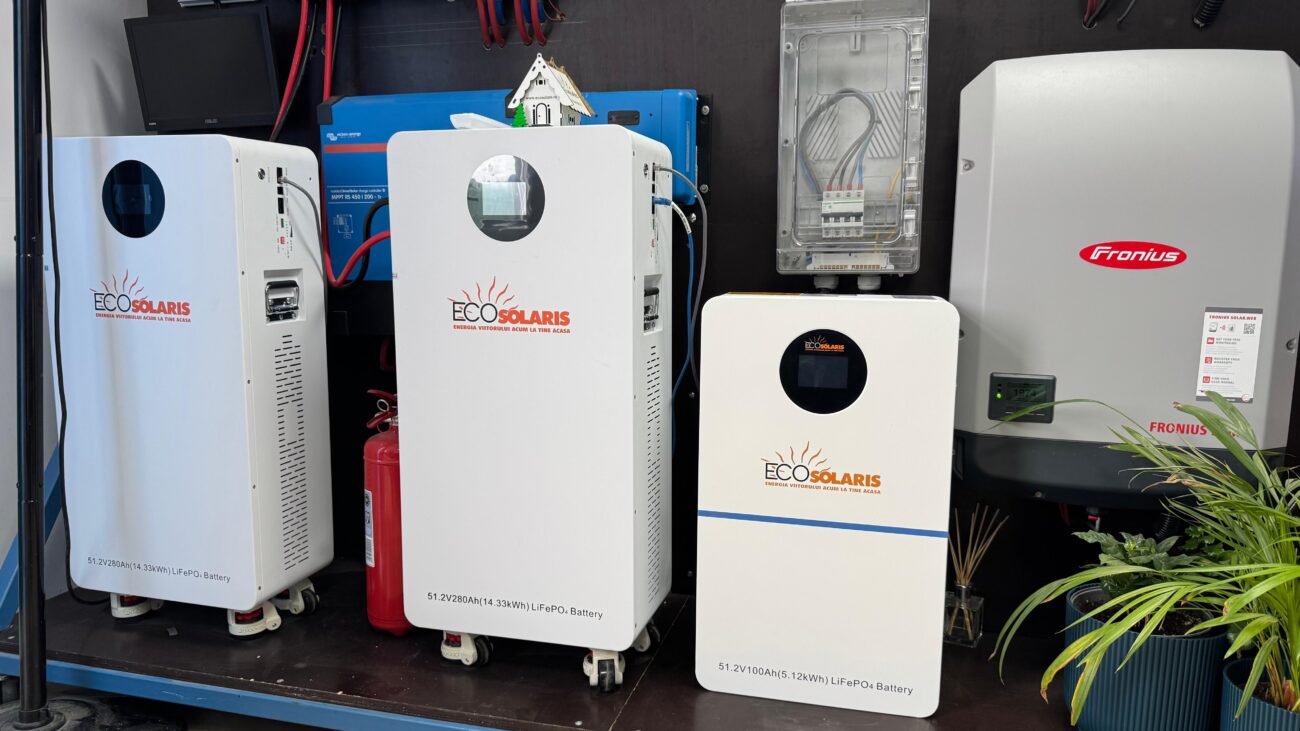
- Lithium-ion batteries: Dominates the market due to high energy density, long life cycle and superior efficiency. However, the relatively high cost and safety concerns (fire risk) represent disadvantages.
- Variants: Lithium-iron-phosphate (LiFePO4) offers increased safety, while lithium-nickel-manganese-cobalt (NMC) has a higher energy density.
- Lead-acid batteries: A mature and accessible technology, but with a limited lifespan and a low energy density. Mainly used in reserve storage systems.
- Redox flow batteries: Designed for large-scale applications, offering long life and excellent scalability. Disadvantages include low energy density and the need for large installation spaces.
- Variants: Vanadium redox (VRFB), zinc-bromine (ZnBr), iron-chromium (FeCr).
Thermal Energy Storage (TES)
This method stores solar energy in the form of heat, using various materials and techniques:
- Storage of sensible thermal energy: It is based on increasing the temperature of a material (water, rock, concrete) to store energy.
- Storage of latent thermal energy: Uses the phase change of a material (eg melting and solidification) to store and release energy.
- Thermochemical energy storage: Involves reversible chemical reactions to store and release energy.
Mechanical energy storage
- Hydropower pumping: A mature and efficient technology that stores energy by pumping water to a higher level and releasing it through turbines to generate electricity.
- Steering wheels: Stores kinetic energy in a rotor that rotates at high speed. Suitable for applications that require fast energy discharges.
- Compressed air: Compress air in underground tanks or specialized containers, releasing it later to generate electricity.
Advantages of solar energy storage
- Energy independence: Reduces dependence on the electrical network and promotes self-consumption.
- Network stability: Contributes to the balancing of the electrical grid, mitigating fluctuations caused by intermittent renewable sources.
- Reducing energy costs: Allows users to store cheap energy produced during the day and use it during peak consumption periods.
- Energy security: Provides a backup power source in case of power outages. [#$$#]
- Environmental benefits: Reduces greenhouse gas emissions and promotes the use of clean energy.
Considerations when choosing a storage system
- Energy needs: Analyze the consumption profile and determine the capacity and power requirements.
- Battery type/technology: Choose the right storage technology depending on the application, budget and performance.
- Costs: Evaluate the initial costs, operating and maintenance costs, as well as the lifetime of the system.
- Integration with the existing system: Make sure that the storage system is compatible with the photovoltaic system and the electrical network.
- Safety: Consider safety issues such as the risk of fire or exposure to chemicals.
The future of solar energy storage
Continuous research and innovation in the field of solar energy storage promise an increase in efficiency, a reduction in costs and a diversification of available technologies. Emerging trends include:
- Next generation batteries: Solid-state batteries, lithium-sulfur batteries, sodium-ion batteries.
- Large scale energy storage: Storage systems connected to the grid, energy storage in hydrogen.
- Integration with artificial intelligence: Performance optimization through automatic learning algorithms.
Solar energy storage plays a crucial role in accelerating the transition to a sustainable energy system. The adoption of these technologies allows access to clean, reliable and affordable energy for everyone.