







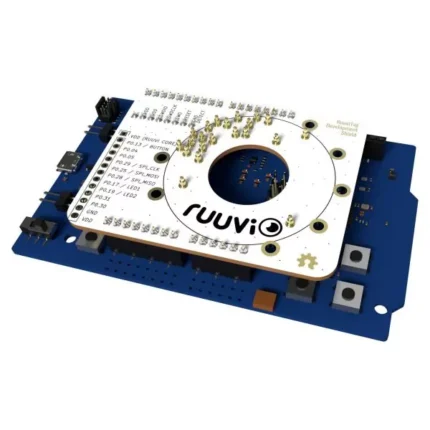
The development kit RuuviTag Development Kit is an advanced open-source platform designed for engineers, developers and hobbyists (makers) who want to build custom wireless sensor solutions.
This kit provides full hardware and software access, allowing users to reprogram the device and integrate Ruuvi sensors into their own IoT (Internet of Things) projects and networks.
Main Features
- Open-Source Platform: Both the hardware design and the software (firmware) are completely open, providing maximum flexibility for customization and experimentation.
- Multiple Sensors (4-in-1): Each included RuuviTag measures four key parameters:
- Temperature
- Relative Air Humidity
- Air pressure
- Movement (Accelerometer)
- Software Flexibility: Users can use the default firmware or develop and upload their own firmware using popular SDKs (Software Development Kits) such as the nRF Connect SDK.
- Multiple Radio Protocols: In addition to the default Bluetooth Low Energy (BLE), the hardware supports a variety of other 2.4 GHz protocols, including ANT, Wirepas Mesh and Lumenradio Mesh, enabling the creation of complex networks.
- Advanced Hardware: The motherboard includes a Nordic Semiconductor nRF52832 System-on-Chip (SoC) with an ARM® Cortex™-M4F CPU, 512kB Flash memory and 64kB RAM, providing enough processing power for complex applications.
- NFC connectivity: Includes a built-in NFC™-A antenna for setup or proximity interactions.
- Buttons and LEDs: The integrated circuit board features two buttons and two LEDs (green and red) for direct interaction and troubleshooting.
Package Contents
Although the exact contents can vary, a standard development kit usually includes:
- A unit RuuviTag (or more) with IP67 waterproof and dustproof housing.
- A CR2477 battery.
- Access to detailed technical documentation and development resources (links to GitHub repositories, code examples, schematics).
Typical Development Applications
- Custom firmware creation for specific use cases (eg: logger, repeater, scanner modes). [#$$#]
- Integrating sensor data into third-party cloud platforms via HTTP/MQTT protocols.
- Rapid prototyping of low-power IoT solutions.
- Development of mesh networks with an unlimited number of nodes using compatible technologies.












Reviews
Clear filtersThere are no reviews yet.