



This one photovoltaic glossary contains fish 44 essential terms for anyone who wants to understand PV technology and make informed choices when investing in a solar system. The definitions are explained in clear language, with practical examples from the experience of EcoSolaris Romania.
A
AC
Alternating current — the form of electricity used in the home and the public grid. The inverter converts the DC current (from the panels) into AC.
AFM
The Environment Fund Administration — the authority that administers the financing programs for photovoltaics in Romania (Casa Verde, Electric Up, etc.).
ANRE
The National Energy Regulatory Authority — the authority that regulates the energy sector in Romania. Photovoltaic installations must be carried out by ANRE certified electricians.
B
BMS
Battery Management System — the electronic system that protects batteries (especially LiFePO4) from overcharging, deep discharging and extreme temperatures. Essential for life span.
Bypass diodes
Diode built into the panel that allows current to bypass a shaded cell, preserving the panel's output.
C
Green House 2026
The AFM program that offers vouchers of up to 20,000 RON for the installation of residential photovoltaic systems.
Solar cell
The basic component of a photovoltaic panel — a semiconductor device that converts sunlight directly into electricity (photovoltaic effect).
Cycle
For batteries: a full charge followed by a full discharge. LiFePO4 batteries support 4000-6000 cycles, vs 500-800 for lead-acid.
D
DC
Direct current — the form of electricity produced by photovoltaic panels. Must be converted to AC by inverter for home use.
DoD (Depth of Discharge)
The percentage of a battery's capacity that has been used. For LiFePO4, the maximum recommended DoD is 80-90% (vs 50% for lead-acid).
E
ESS (Energy Storage System)
Energy storage system — in a photovoltaic context, LiFePO4 batteries that store surplus for later use.
Panel efficiency
The percentage of solar energy that a panel converts into electricity. Premium panels have an efficiency of 22-23%, standard ones 19-21%.
H
HJT
Heterojunction — advanced photovoltaic panel technology with 22-24% efficiency, superior performance at high temperatures.
Hybrid (System)
Photovoltaic system that combines on-grid (grid connection) with off-grid (batteries). Provides automatic backup in case of voltage drops.
I
IP65 / IP67
Dust and water protection index. IP65 = protected against water spray, IP67 = protected against temporary immersion.
Optimal tilt
The ideal mounting angle of the panels for maximum efficiency. For Romania, 30-35° from horizontal (equal to latitude).
Inverter
The device that converts DC current from panels to AC for household and mains consumption. Types: on-grid, off-grid, hybrid, microinverter.
Hybrid inverter
Inverter that can manage panels, batteries and the public grid simultaneously. Allows automatic backup and consumption optimization.
L
LiFePO4
Lithium Iron Phosphate — the safest and most durable lithium battery chemistry (4000-6000 cycles). Standard for modern photovoltaic systems.
M
MPPT
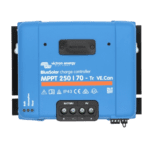
Maximum Power Point Tracker — electronic circuit that optimizes the power extracted from the panels in real time. Essential for maximum performance.
Micro Grid [#$$#]
Medium PV system, standalone or hybrid, for communities, farms, residential complexes (5-50 kW typical).
Microinverter
Small inverter mounted on the back of each panel. Allows individual optimization — good for partially shaded roofs.
Mono / Monocrystalline
Photovoltaic panel made of monocrystalline silicon (a single crystal). The most efficient technology. Recognized by the uniform black color.
N
N-type
Type of silicon used in advanced photovoltaic cells (TOPCon, HJT). More stable, better performing than the traditional P-type.
O
Off grid
100% autonomous photovoltaic system, without grid connection. It necessarily requires batteries to store energy.
On-grid
Photovoltaic system connected to the public grid. You sell the surplus as a prosumer. It does not work when the network drops (anti-islanding).
P
PERC
Passivated Emitter Rear Cell — standard PV panel technology, 19-22% efficiency, very good value for money.
PNRR
The National Recovery and Resilience Plan — European funds that include financing for photovoltaic projects in Romania.
PV
Photovoltaic — English term for photovoltaic. See PV panel, PV system.
PWM
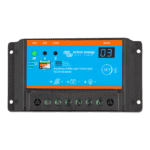
Pulse Width Modulation — simple battery charge controller (vs more advanced MPPT). Used for small off-grid systems.
Polycrystalline
Photovoltaic panel made of multiple silicon crystals. Lower efficiency than mono (16-18%), blue appearance. Almost off the market.
Prosumer
Natural or legal person who produces and consumes electricity. In Romania, it sells the surplus at the purchase price (quantitative compensation).
S
STC
Standard Test Conditions — laboratory conditions for panel testing: 1000 W/m² irradiation, 25°C, AM 1.5. The displayed power is at STC.
Self-consumption
Self-consumption — the percentage of energy produced that is used directly (vs exported to the grid). With batteries, it can reach 70-90%.
Solar Edge / Optimizer
Device that optimizes the performance of each individual panel. Useful for complex or partially shaded roofs.
String
Chain of panels connected in series. A system has one or more strings connected to the inverter.
T
TOPCon
Tunnel Oxide Passivated Contact — advanced N-type technology with 22-23% efficiency, superior performance at high temperatures. Trend 2026.
Tier 1
Bloomberg ranking for solar panel manufacturers with the best financial stability. LONGi, Canadian Solar, Trina are Tier 1.
V
V2G / V2H
Vehicle-to-Grid / Vehicle-to-Home — technology that allows the electric car to supply energy back to the home or grid.
VRM (Victron)
Victron Remote Management — the remote monitoring platform for Victron equipment (inverters, batteries, controllers).
Casa Verde voucher
The lump sum (up to 20,000 RON in 2026) offered through the Casa Verde program for the installation of a residential photovoltaic system.
W
Wp / W peak
Watt-peak — the maximum power of a panel under STC conditions. A 400Wp panel produces a maximum of 400W under ideal conditions.
K
kWh
Kilowatt-hour — unit of measurement of energy consumed or produced. An average house consumes 4,000-5,000 kWh annually.
kWp
Kilowatt-peak — the maximum rated power of a photovoltaic system under standard test conditions (STC).
💡 Have questions? The EcoSolaris team helps you with free technical explanations. Contact us or call at +40 728 022 022.